


One Friday in my early twenties, I went to stay the night at a friend’s house in western Massachusetts. As a child, I’d gone to summer camp not far away from here, in a place where gravel roads crossed lush green fields, a place full of song and prayers and late-night talks in cabins. Winters in the Berkshires were quieter, the branches all bare—but the place still held a cold, bright magic.
On Saturday morning, my father called. A snowstorm was moving in, and although we’d originally discussed me returning to Boston that evening, he thought I should depart sooner so that I could avoid the worst of the weather. I too had seen the forecast, and knew that leaving midday was to risk driving through the storm—that in fact, the safest course of action was probably to wait until Sunday, when the roads would be better plowed. But I’d already tried to haggle with him about staying the entire weekend, and I knew this would just sound like an excuse to get what I’d wanted all along. (And could I really be certain that wasn’t motivating my decision?) So I relented and gathered my belongings, and as the first few flakes began to fall, I began to drive.
An hour or so into the journey, the snow had begun to seriously accumulate. Not many other cars were on the highway, and the few that I saw were, like me, driving considerably below the speed limit. Two tire grooves formed in the snow in the left lane, while the others were blanketed over, so I followed the tracks and didn’t stray from them. Then, apropos of nothing, the car began to skid. Helplessly clutching the wheel, I zig-zagged across all three highway lanes, powerless to stop the death glide, cursing my stupidity that I hadn’t just waited until Sunday to leave. Within a few seconds, I came to rest against the right guardrail with a soft bump. (God knows what would have happened if there had been no barrier, or other cars were around.) For a moment I just sat in the driver’s seat, breathing.
In the end, the car sustained only a tiny dent on the rear bumper, and I arrived home unscathed (but for a mild case of self-righteousness). It had taken me over four hours to complete what should have been a two-and-a-half hour journey. This is hardly the worst crash I’ve been in—but it’s nevertheless the one which has stuck with me the most, and what it taught me was this: Just because someone is arguing out of self-interest does not make their position incorrect. Let’s call this principle (or, rather, the mistake to be avoided) the pure motive fallacy.1
We should be wary of motivated reasoning when we spot it in ourselves or others. Motivated reasoning is almost always a necessary precondition of bad decisions—it’s just not a sufficient one. Too often, the moment we detect a hint of bias, we simply stop engaging with the argument. And sometimes the desire to seem unbiased—to be confident of the purity of our intentions—can itself become a corrupting influence in the opposite direction, as I (almost) learned the hard way that fateful day on the Massachusetts turnpike. The truth is, there is virtually always a thumb on the scale in one direction or another, and merely knowing it is there doesn’t excuse us from the difficult work of weighing.
If we wanted to get very reductive about this (and of course I do), we could boil it down to a simple two-by-two table: what’s good for you; and what is actually the right choice/good for the world. We can then classify actions like so…2
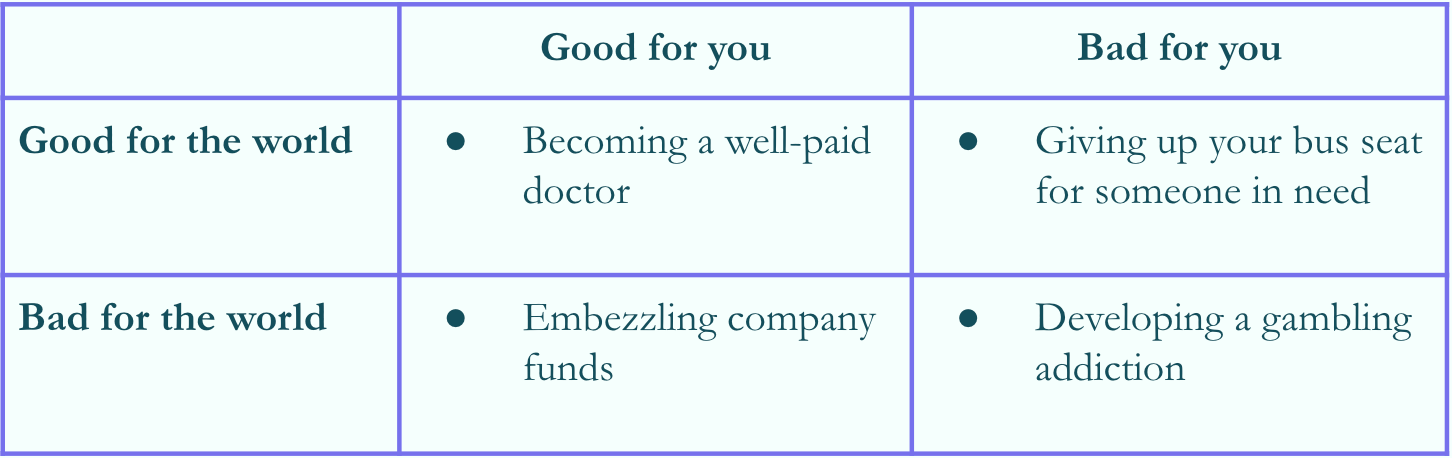
One corollary of this framework is that we’re most likely to get positive behaviors when individual incentives are well aligned with societal benefit. This is the left side of the table, the realm of homo econonomicus, and in market-based transactions it is usually compelling logic: People do seem to perform valuable work because they are compensated for it, and appropriate punishments do help deter bad behavior.
But in the quieter settings of our day-to-day lives, the logic is often flipped.3 That is, when interacting with people we care about, the personal costliness of a decision becomes a feature rather than a bug—the sacrifice a demonstration of love or humility, and a source of shared intimacy. This is one of the primary reasons why people end up in the top right quadrant (“bad for me” + “good for the world”). As Lewis Hyde describes in The Gift:
When gifts are sold, they change their nature as much as water changes when it freezes, and no rationalist telling of the constant elemental structure can replace the feeling that is lost…Our generosity may leave us empty, but our emptiness then pulls gently at the whole until the thing in motion returns to replenish us.
In this context, the more unimpeachable our altruism is—the harder it is to say we had a secret agenda—the better everyone feels about the interaction.
(I haven’t said too much about the bottom right, lose-lose quadrant, but this captures a suite of self-destructive behaviors that also have negative externalities on others—sometimes glossed as “sucks to be you, sucks to be around you.” These situations show that suffering is not inherently virtuous, and that we should be suspicious of anyone who valorizes pain for its own sake.)
My broader point, again, is that being biased and being correct are not mutually exclusive.4 This raises the difficult question of how to know when bias is a negligible factor, and when it really is overwhelming our decision making. Here, our best defense is probably other people, who can help us see outside our self-interest. Absent this, certain best practices can help: making an explicit model with falsifiable predictions; disaggregating your judgment into smaller subdecisions; and delaying intuition for as long as possible.
Good drivers know that when your car begins to skid, the last thing you want to do is fight against the drift. Instead, counterintuitively, you should gently steer into the skid; rather than fight momentum, put the wheels on the same vector the car is already traveling, and regain control of the vehicle.
Similarly, I think the best response to self-interest is not to tense up and jerk the wheel in the opposite direction, pretending bias isn’t present. Instead, gently steer toward the private motives and regain control of the decision. Self-interest is a valid input to decisions—but it’s just one of many, and rarely the most important. Name it, assess it, and ask what else matters.
“Pure motive fallacy” is just a particular case of the ad hominem fallacy (i.e., focusing on the attributes of the arguer rather than substance of their argument), but it’s a case that seems to come up particularly often and therefore I think worthy of its own name.
This classification is just about the obvious/immediate effects of action, which of course is not the whole story. Human nature means that many “selfless” acts could, in a deeper sense, be self-benefiting because they bring psychological or social rewards. I’m mostly avoiding discussion of these second-order effects in this post.
You probably know some people who only seem to operate in transaction mode in their interpersonal relationships, and how offputting this can be. Few shows epitomize this type of person better than It’s Always Sunny in Philadelphia. In one typical demonstration, a character’s announcement that he’s written a musical is met by questions like “who’s the mark?” and “what’s your angle?” (“I just wrote a musical to write a musical!” he insists. “I don’t have an ulterior motive here. I’m not trying to screw anyone or gain anything out of it.”) In fact, he does have an ulterior motive—namely, using the musical as an opportunity to woo the waitress who has repeatedly rebuffed his romantic advances.
H/t to Charlie Holtz who shared this example with me a while ago.
Reading this, a skeptic might say: Isn’t this an awfully convenient argument to be making? Do people really need *more* permission to act in their own self-interest? Unfortunately, this criticism is itself an example of pure motive fallacy. Of course it’s self-serving to think our bias might be aligned with what’s actually right! That doesn’t tell us whether or not the belief is correct.