

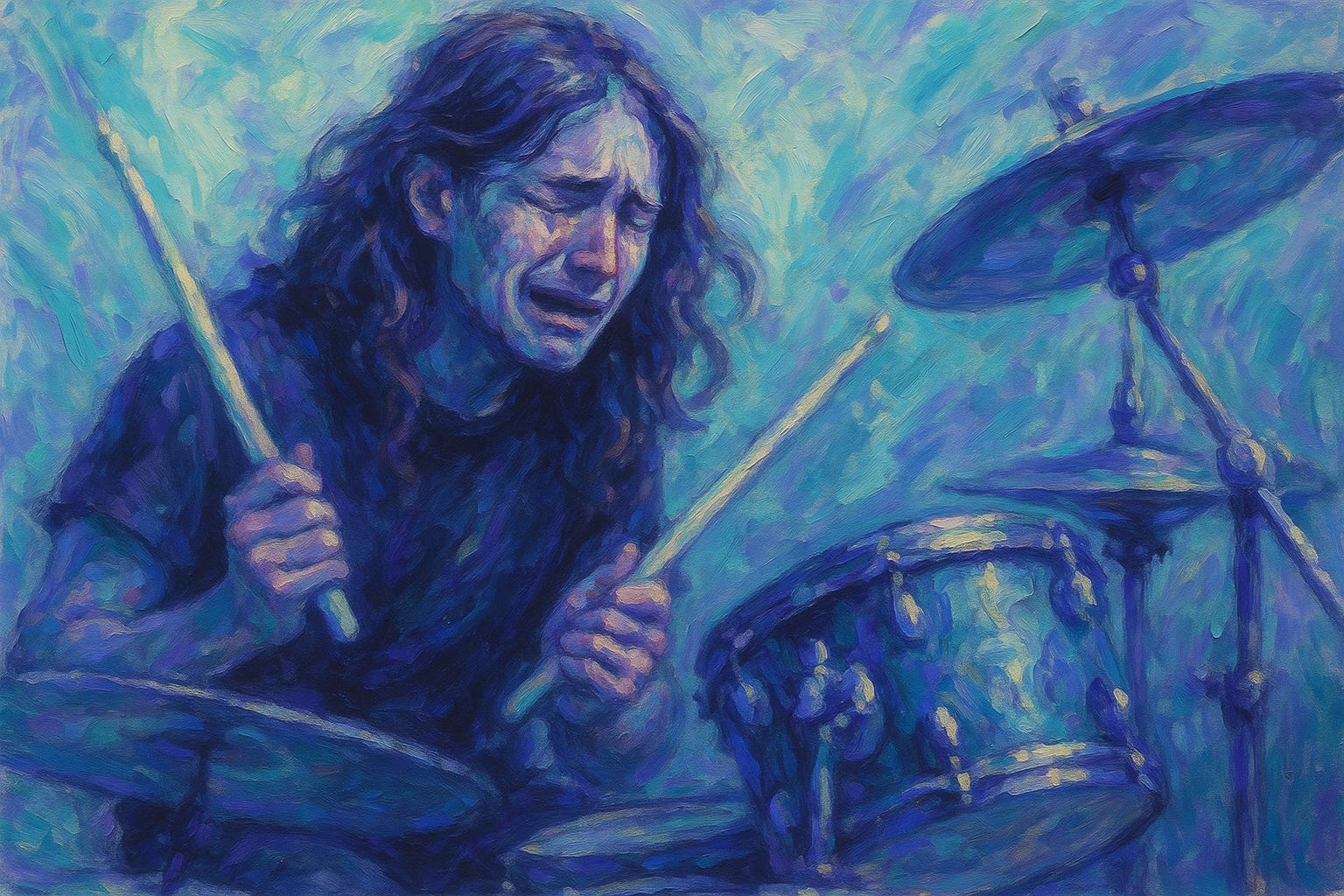
A few months ago, while visiting Maine, a couple friends of mine stopped by a local bar. The bar, usually the haunt of locals, was on this night strangely overrun with young people, and my friends soon realized they’d stumbled onto an unofficial graduation event for Bowdoin College.1 Out back, a student band was playing, and it was clear all their classmates had come to see them play this final sendoff show. The band was visibly emotional. Many in the audience were weeping as they sang along to the lyrics. At one point toward the end, tears streaming down his face, the drummer took an absolutely gratuitous solo, smashing the toms and cymbals for nearly an entire minute—the grand, trembling crescendo to the wave that, after four unforgettable years, they had all finally ridden to its end.
I’d like to go to more events like this.
Instead, I more often find myself in a different kind of situation: I learn that a musical artist I like is on tour, or a friend invites me to go to a show with them. I cough up what was already too much money before the $26 Ticketmaster processing fee, and add the event to my calendar. When the night arrives, the artist puts on a show that invariably sounds and looks great, with seamless transitions between songs and a pre-selected encore; but the whole thing feels slightly curated, a performance of an authentic performance. There is little sense—as with the student band my friends chanced upon—that the concert is in any way unique, something only possible with this group of people on this particular night.
The experiences I’m describing are not unique to concerts, but rather archetypal of two different approaches to how one might spend a night: The first approach is riskier, doomed to fail a large fraction of the time—but oh so sweet when it hits. The second approach is more reliable, but limited in its upside; you know the event will be good, but it will rarely wildly exceed your expectations.
I want to make the case for the first approach, for more high-variance living.
Seeking out higher-variance experiences can feel difficult to justify in an age with so much information at our fingertips: Yelp, Goodreads, Wirecutter—for any given thing you want to try, you can usually vet and filter to ensure you are getting the best.
The catch here is that all this vetting and filtering is based on averages. This means that you are indeed optimizing for a kind of “best,” but this “best” is defined as what most people don’t hate—a reasonable definition but not the only one. It means you’ll tend to select for things that are broadly pleasing but rarely idiosyncratic—certainly never polarizing. You’ll be maximizing the floor while somewhat capping the ceiling.
There are plenty of situations where it does make sense to simply maximize the floor. If you’re buying a new mattress or stopping for food on a road trip, it’s probably more important to guard against extreme shittiness than seek out life-altering joy. But a life that is entirely not terrible will soon become flat and anemic compared to one that invites greater serendipity. If you reflect on your most cherished memories and friends, I think you’ll see that this is true, that chance played a significant role: the scarf you bought on a long-ago trip; the meet-cute at the coffee shop. These special occurrences aren’t the result of radical life choices, but they do require a certain openness to experience; they could not have been predicted in advance, served up by an Amazon algorithm or TikTok feed.
“High variance” living, in other words, doesn’t mean buying a houseboat, or leaving your forty-year marriage, or putting it all on red (although for some perhaps it could). It simply means introducing a bit more uncertainty into the quotidian decisions of where you go and who you interact with, what you read, watch, and listen to. These choices feel small, but they compound.
Of course different people will have different personal preferences and naturally favor more or less predictability in their lives. Still, if I had to guess, I’d say most of us err in the direction of too little variance than too much. There are many psychological and economic forces pushing us toward reliably-good-but-rarely-amazing outcomes: As a society, we’ve seen this phenomenon in the increasing dominance of remakes and sequels; you’ve probably experienced a similar effect firsthand if you’ve ever watched a video or online shopped and then start getting served only content of that type. A steady stream of media pushes us toward what the machine “knows” already works—but with each recapitulation, the thing becomes more and more stale.2 In the long run, the only thing that truly works is a healthy infusion of novelty.
I also believe that even when it disappoints us, there are certain psychological benefits to high-variance living. When you research meticulously or purchase an expensive ticket, you go in with higher expectations. These expectations create much more room for negative surprises than positive ones; in the back of your head, a part of you is always monitoring to see whether you’re getting your money’s worth. By contrast, when you go in with less information (or simply put yourself in situations where unexpected things are more prone to happen), you create more room for positive surprises. When things go well, you feel as if you’ve found a hidden gem, and get an extra release of dopamine. Even when they don’t go well, you’re more likely to get a good story out of it, or at least not have lost much.3
High-variance living doesn’t mean embracing uncertainty in every situation—usually just when the stakes are low-ish and mistakes can be corrected. It doesn’t mean deliberately seeking out bad experiences, or avoiding easy steps to mitigate downside. It simply means identifying a few pockets in your day or week that crackle with adventure, where the promise of surprise is still alive.
It’s possible I have the school wrong here or have botched a few other details of this story—but these are immaterial to my larger point.
Serving you more of what you’ve already consumed is rational in the sense that you’re more likely to respond positively to it than to any specific piece of content they might have shown you instead; but it’s far more probably that you’d like something novel if the algorithm could only determine what that something was. “More of the same” is a bet on the known plurality-preferred option over the unknown majority-preferred option.
Going to free and cheap events is a great way to practice high-variance living in part because it’s much easier to bail if you’re having a bad time.
Some of the greatest concerts and shows I’ve been to are events that I knew little about in advance! In fact I enjoy going to plays with little preconceived notion and learning more after the fact. Of course this doesn’t always produce the best experience, but IMHO, it’s worth the risk. In other words, I agree with you.